
In the age of rapid digital transformation, AI has seeped into almost every industry, revolutionizing how we conduct business, design products, and even create content. The ClusterMagic service is a great example, which seamlessly integrates AI for content generation in a hybrid model, providing significant benefits in the SEO results of brands seeking a massive increase in organic traffic. But while AI holds immense promise, it has its limitations. Let's explore the pros and cons of using AI for content creation and understand why a hybrid approach might be the way forward.
Major publishers in sensitive niches like CNET.com, Bankrate.com, and Creditcard.com have already integrated AI-generated content. Other large companies, such as CNN and Forbes, might also be doing so. Countless smaller companies and publishers are utilizing AI, not only on their websites but also on social media, in email marketing, and virtually everywhere else.
Google's stance on AI-generated content is neutral, emphasizing that content should primarily be user-centric. In fact, Google's September 2023 Helpful Content Update removed the mention of "written by people" from their helpful content system guidelines.
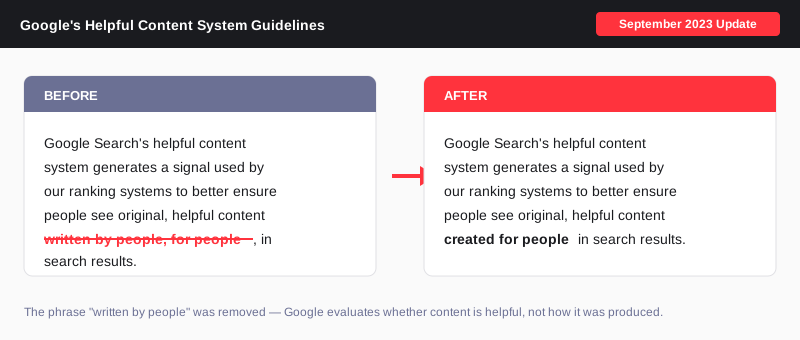
The message is clear: for content to rank well, it must be informative, answer users' queries satisfactorily, and showcase genuine expertise - regardless of how it's created.
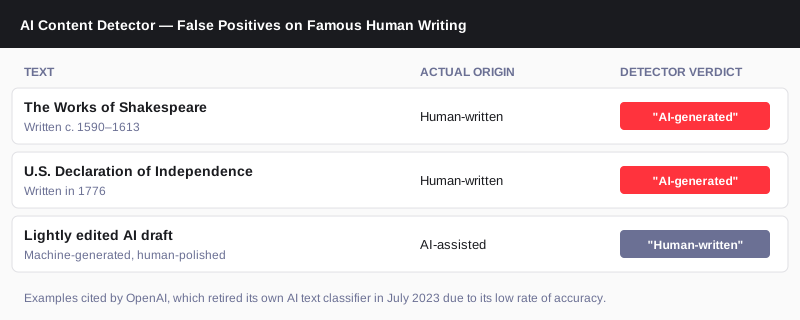
AI Content Detectors like GPTZero, ZeroGPT, and many others are not reliable. Even OpenAI has said as much. They consistently produce false positives about human-written content. Conversely, they can be easily fooled with creative prompting or a bit of human editing.
An interesting note from OpenAI: "we found that it labeled human-written text like Shakespeare and the Declaration of Independence as AI-generated."
Anecdotal evidence and real-life ranking data suggest that while AI-generated content isn't penalized by search engines, it might only achieve high rankings if it meets the above criteria. The role of AI in content creation is still a developing narrative, and its significance is indispensable for maintaining a competitive edge in the future.
At EmberTribe, the understanding is clear - AI serves as a foundation, not the final product. With ClusterMagic, while AI aids in the initial draft based on expert-driven keyword research, human experts step in for the crucial phases of editing, fact-checking, and final review. This hybrid approach ensures the content is accurate and helpful, has the potential to rank, and truly represents their business.

In the age of rapid digital transformation, AI has seeped into almost every industry, revolutionizing how we conduct business, design products, and even create content. The ClusterMagic service is a great example, which seamlessly integrates AI for content generation in a hybrid model, providing significant benefits in the SEO results of brands seeking a massive increase in organic traffic. But while AI holds immense promise, it has its limitations. Let's explore the pros and cons of using AI for content creation and understand why a hybrid approach might be the way forward.
Major publishers in sensitive niches like CNET.com, Bankrate.com, and Creditcard.com have already integrated AI-generated content. Other large companies, such as CNN and Forbes, might also be doing so. Countless smaller companies and publishers are utilizing AI, not only on their websites but also on social media, in email marketing, and virtually everywhere else.
Google's stance on AI-generated content is neutral, emphasizing that content should primarily be user-centric. In fact, Google's September 2023 Helpful Content Update removed the mention of "written by people" from their helpful content system guidelines.
The message is clear: for content to rank well, it must be informative, answer users' queries satisfactorily, and showcase genuine expertise - regardless of how it's created.
AI Content Detectors like GPTZero, ZeroGPT, and many others are not reliable. Even OpenAI has said as much. They consistently produce false positives about human-written content. Conversely, they can be easily fooled with creative prompting or a bit of human editing.
An interesting note from OpenAI: "we found that it labeled human-written text like Shakespeare and the Declaration of Independence as AI-generated."
Anecdotal evidence and real-life ranking data suggest that while AI-generated content isn't penalized by search engines, it might only achieve high rankings if it meets the above criteria. The role of AI in content creation is still a developing narrative, and its significance is indispensable for maintaining a competitive edge in the future.
At EmberTribe, the understanding is clear - AI serves as a foundation, not the final product. With ClusterMagic, while AI aids in the initial draft based on expert-driven keyword research, human experts step in for the crucial phases of editing, fact-checking, and final review. This hybrid approach ensures the content is accurate and helpful, has the potential to rank, and truly represents their business.


Most B2B SaaS companies outgrow generalist marketing help faster than they expect. The moment you're optimizing for pipeline quality, CAC payback, and expansion revenue simultaneously, a generalist agency that doesn't understand recurring revenue models becomes a liability. A specialized b2b saas marketing agency is built for that environment specifically.
This guide explains what these agencies do, how their work differs from standard B2B or DTC marketing, and how to evaluate one before committing budget.
SaaS has structural dynamics that generalist agencies consistently underestimate. The most significant: acquiring a customer is not the goal. Retaining and expanding that customer is what drives compounding ARR growth.
A generalist agency optimizing for lead volume can look productive while your funnel economics deteriorate. They may drive MQL counts up while CAC climbs and payback periods stretch. Benchmarkit's 2025 SaaS benchmarks show that the average B2B SaaS company now spends $2.00 in sales and marketing for every $1.00 of new ARR, and the average sales cycle has extended to 134 days. Neither of those realities is reflected in how most general-purpose agencies plan or measure work.
SaaS-specific agencies understand the buying committee problem. Enterprise SaaS deals typically involve six to ten stakeholders, each with different concerns, at different stages of awareness. Campaigns that reach only the economic buyer while ignoring the security team, the end users, and the IT evaluators leave enormous conversion opportunity on the table.
The best SaaS agencies are full-funnel rather than channel-narrow. Their service mix typically includes:
Demand gen for SaaS is not a synonym for lead generation. It encompasses the full motion of creating awareness, educating the market, and moving qualified buyers from dark funnel to pipeline. Agencies that lead with demand gen typically build integrated programs across content, SEO, paid search, and paid social rather than running those channels in isolation.
Good demand gen programs are tracked against revenue-connected metrics: cost per SQL, pipeline influenced, and CAC payback. See our breakdown of the metrics that actually matter for SaaS growth for what a rigorous measurement framework looks like at each funnel stage.
ABM flips the traditional funnel. Instead of casting wide and filtering down, you identify the accounts most likely to become high-LTV customers and build campaigns specifically for them. A SaaS-focused ABM program typically includes firmographic targeting on LinkedIn and programmatic display, personalized content for each target segment, and coordinated outreach sequences timed to buying signals.
Gartner's B2B buying research shows that B2B buyers spend only 17% of their total buying process talking to potential vendors. The rest is independent research. ABM closes the gap by placing your content and messaging inside that research window before a prospect ever raises their hand.
Organic search is the most scalable channel for SaaS companies with long sales cycles because content compounds over time while paid spend does not. A SaaS-specialized agency approaches content differently than a generalist: they map content to buying stages, prioritize topics based on commercial intent, and build topical authority rather than chasing isolated keyword rankings.
The content strategy also serves sales enablement. High-quality comparison pages, technical guides, and use-case documentation reduce friction in the sales cycle and shorten time-to-close. Internal linking between those assets reinforces both SEO and buyer education simultaneously.
SaaS paid programs require a different bidding logic than e-commerce. You're not optimizing for a single transaction; you're optimizing for pipeline quality. That means targeting by job title, company size, and intent signals rather than demographic lookalikes, and measuring success by SQL volume and pipeline contribution rather than click-through rate.
LinkedIn Ads is the dominant B2B paid social channel for SaaS because of its firmographic targeting precision. Agencies that specialize in SaaS typically run thought leadership ads, sponsored content, and retargeting sequences layered on top of each other, rather than running single-offer campaigns.
Most SaaS buying decisions don't happen on the first visit. Prospects enter the funnel, go dark, reengage months later, and convert after multiple touchpoints. Effective nurture sequences segment by ICP fit, engagement level, and buying stage, serving content that matches where each prospect actually is. Agencies with SaaS expertise build these systems in HubSpot, Marketo, or similar platforms, and they wire attribution tracking so every touchpoint is connected to revenue outcomes.
The differences show up in measurement first. A general B2B agency will typically report on impressions, clicks, and MQL volume. A SaaS-specialized agency ties everything to SQL creation, pipeline influenced, and CAC payback. If an agency can't articulate how their work connects to revenue, they're operating at the wrong level of accountability for a SaaS business.
The second difference is channel mix. Generalists tend to default to whatever channel they execute best. SaaS agencies build programs around where B2B SaaS buyers actually spend time: LinkedIn, targeted podcast sponsorships, review sites like G2 and Capterra, and high-intent search terms. They also tend to have stronger opinions about what not to do, particularly around vanity metrics and low-intent lead sources that inflate volume without improving pipeline.
Third is understanding of the SaaS sales motion. An agency that has never worked with a product-led growth model, a self-serve freemium funnel, or an enterprise direct-sales motion will be learning on your budget. Agencies that have worked across multiple SaaS growth stages bring frameworks you can skip straight to rather than rebuilding from first principles.
Ask for case studies from companies at a comparable ARR stage and growth motion. An agency that has worked primarily with early-stage PLG companies may not be the right fit for a $10M ARR company transitioning to enterprise direct sales. The specifics matter.
Request a sample report or attribution model before signing. If their standard reporting doesn't include pipeline contribution or CAC payback, they're not measuring what matters. Strong agencies connect every channel to revenue impact, even when attribution is imperfect.
Some agencies present a strategy and hand execution off to your team. Others own the full execution stack. Know what you're buying before you sign. If your internal team is thin, an agency that does strategy-only will leave you without the capacity to execute against the plan.
Our growth strategy consulting overview covers when to bring in external strategy versus execution help.
Most mid-market SaaS agencies charge $8,000 to $15,000 per month for a retainer covering strategy and multi-channel execution. Enterprise-level engagements run $25,000 to $50,000 per month. Flat-fee retainers are preferable to percentage-of-spend models because they align the agency's incentives with efficiency rather than media volume.
Avoid agencies that require six to twelve month minimum commitments without performance milestones built in. A confident agency will agree to quarterly checkpoints with defined metrics.
Long setup periods with no deliverables, reporting that defaults to impression and click metrics, inability to explain how they attribute pipeline, and case studies from industries entirely unlike SaaS are all warning signs. So is any agency that pitches a "proprietary methodology" without being able to explain the underlying mechanics.
A well-run SaaS agency engagement delivers measurable progress within one quarter. Not necessarily closed revenue, but leading indicators that are moving in the right direction: SQL volume increasing month over month, cost per SQL declining as targeting sharpens, organic traffic growing on high-intent terms, and a documented attribution model that shows where pipeline is being created.
By month three, you should have a clear picture of which channels are generating qualified pipeline and which are not. If the agency can't show you that, the engagement is running on faith rather than data.
The SaaS brand building dimension matters here too. Demand gen without brand investment creates a ceiling that compounds over time. Companies that build category awareness alongside direct response programs consistently outperform those running paid channels alone.
EmberTribe works with growth-stage B2B SaaS companies to build integrated demand gen programs that connect organic, paid, and content into a single revenue-accountable system. Every engagement starts with ICP alignment and attribution setup before any campaign goes live, because the measurement infrastructure is what separates programs that compound from ones that plateau.
If you're evaluating marketing partners for your SaaS company, the first conversation should be about your funnel economics, not your budget. Learn more about how EmberTribe structures SaaS growth engagements or explore the full range of EmberTribe services.
The search for the best digital marketing firms typically starts after a growth plateau or a failed agency relationship. By that point, most teams have already learned what a generic vendor looks like: broad service menus, account manager overhead, and reporting that describes activity rather than results. Finding a firm that actually moves revenue requires a different evaluation framework, starting with specialization and structure before getting to price.
The distinction between a "firm" and an "agency" is largely semantic in marketing, but it signals something about positioning. Firms tend to imply structured engagements, deeper specialization, and senior-level execution rather than delegated account management. What matters more than the label is whether the vendor demonstrates vertical experience in your business model.
Retainer engagements are the clearest proxy for client satisfaction. Clients on retainer contracts stay an average of 56 months versus 24 months for project-based clients, according to InfluenceFlow's 2026 agency benchmarking report, and retainer clients churn at 18% annually versus 42% for project clients. Firms with strong retainer books are building long-term relationships because they deliver measurable outcomes. Firms that default to project work often do so because their results do not justify ongoing investment.
Full-stack firms manage multiple channels: paid search, paid social, SEO, email, and content, all under one roof. They make sense for brands that want integrated execution and attribution without coordinating multiple vendors. The risk is diluted specialization: a firm that runs everything may not be best-in-class at any single channel.
Channel-specific specialists focus on one or two channels and go deep. A paid social firm that manages Meta, TikTok, and Pinterest campaigns exclusively develops pattern recognition across thousands of accounts that a generalist cannot replicate. SEM agencies operating purely in paid search build Google Ads account structures and bidding strategies that general firms rarely match. The tradeoff is coordination complexity when you need multiple channels covered simultaneously.
Vertical specialists focus on a specific business model: DTC ecommerce, B2B SaaS, healthcare, or local services. This is the highest-signal category when the vertical matches your business. A firm that has scaled 30 Shopify brands to $10 million understands creative fatigue cycles, contribution margin targets, and LTV models in ways that a generalist cannot replicate. At the $5 million to $20 million ARR inflection point for DTC brands, vertical expertise begins to matter more than channel depth, because strategic decisions require business model understanding, not just platform mechanics.
The evaluation framework differs significantly between B2B and DTC brands, and the best firms in each category are usually not the same firms.
For DTC and ecommerce brands, creative capability is the most important signal. Creative drives 60 to 70 percent of campaign performance on paid social platforms, according to internal Google data cited by Darkroom Agency. Meta's Andromeda algorithm has further shifted the platform away from audience signals toward creative signals, meaning a firm that produces strong ad creative outperforms one that excels at audience segmentation. Firms that combine performance media buying with in-house creative production are specifically built for this environment.
For B2B brands, account-based marketing capability is the differentiating factor. B2B companies that deploy ABM strategies see 87% higher ROI than those using broad-based approaches, per Forrester Research. The ABM services market reached $1.2 billion in 2024, reflecting how much B2B marketing has shifted toward precision targeting over volume. Firms with ABM-specific expertise (intent data integration, targeted account programs, and sales-marketing alignment) serve a fundamentally different need than firms optimized for DTC acquisition.
Digital marketing firms price in three main structures: flat monthly retainer, percentage of spend, or hybrid. The right structure depends on your stage and the channels being managed.

Flat retainers are common for content, SEO, and full-service engagements. Percentage of spend (typically 10 to 20 percent) is standard for paid media management, where the fee scales with the media budget. Hybrid models split a flat strategy fee from a variable media management fee. Seventy-eight percent of digital marketing firms use retainer pricing as their primary model, per InfluenceFlow 2026, which creates predictable cost for the client and stable revenue for the firm.
Pricing signals something beyond cost. A growth-stage firm charging $2,000 per month for full-service management is almost certainly understaffed or using offshore execution layers. Firms operating in the $3,000 to $7,000 monthly range for growth-stage brands can typically support senior execution on your account.
Boutique marketing agencies with narrow specializations often deliver more output per dollar at this tier than larger shops carrying account management overhead. Understanding how to choose the right marketing agency for your stage matters more than maximizing channel coverage per dollar spent.
The evaluation process should filter on fit, not just capability. These six questions surface the information that separates genuinely strong firms from ones that present well:
What is the average annual revenue of your current clients in my category? The answer reveals whether the firm has pattern recognition at your stage or is learning on your budget.
How many accounts does each strategist manage? More than eight accounts typically means reactive management rather than proactive optimization, regardless of how the firm describes its team structure.
Can you walk through your attribution methodology? Firms that cannot explain how they connect spend to pipeline or revenue are reporting activity, not outcomes.
What was your average client retention period over the last three years? A number below 18 months signals a client satisfaction problem. Strong firms can produce this number without hesitation.
Who specifically will work on my account, and can I meet them before signing? The most common complaint in agency relationships is senior sellers handing off to junior executors after the contract is signed. Insist on meeting the actual execution team.
What does success look like in 90 days, and how will you measure it? Firms that cannot define measurable 90-day milestones are not outcomes-oriented. Clear short-term benchmarks reveal whether the firm has realistic expectations for your category.
Guaranteed ROAS or ranking promises are the most visible red flag in any firm pitch. Results depend on competitive conditions, creative quality, and spend levels that no firm controls entirely. Long-term contracts of 12 or more months with no performance clauses lock clients into underperforming relationships with no recourse. Firms that lead with proprietary technology platforms rather than strategy are often selling software subscriptions with thin service wrappers on top.
Reporting dashboards that show impressions and clicks without connecting to revenue or pipeline are designed to demonstrate activity, not outcomes. A firm worth hiring can explain which dollars drove which results, even approximately. The best digital marketing agencies share the same quality signals regardless of size: they push back on unrealistic expectations, define measurable outcomes before starting, and surface problems before clients notice them.
The strongest predictor of a productive firm relationship is vertical alignment. A firm that has worked with 20 brands at your stage and business model has already encountered your specific problems. They know which channels work at your spend level, where creative bottlenecks typically appear, and what realistic performance looks like in your category. The evaluation time invested in finding vertical alignment pays back in avoided ramp time and failed experiments.
For growth-stage ecommerce and DTC brands evaluating demand generation partners, EmberTribe works on the content and paid media programs that build compounding pipeline rather than isolated campaign spikes.

Most marketing teams have access to more data than ever, yet still struggle to answer a simple question: is our spend working? The problem is not a lack of data. It is a lack of one coherent analytics dashboard that surfaces the right numbers at the right time.
A well-built marketing analytics dashboard eliminates the context-switching between ad platforms, CRM reports, and spreadsheets. It gives your team a single source of truth, enabling faster decisions and tighter feedback loops between creative, media, and revenue.
A marketing analytics dashboard is a centralized, interactive interface that pulls data from multiple sources and displays key performance indicators in one view. The best implementations update in real time or near-real time, automatically refreshing as campaigns run and orders come in.
Unlike static reports, a live dashboard lets you react. You can spot a ROAS drop on a Tuesday morning and adjust bids before the day burns through budget. That speed-to-insight gap is where growth compounds or erodes.
According to Improvado's 2026 dashboard research, the average marketing team now manages data from more than a dozen platforms. Without a dashboard aggregating that data, teams default to manual exports and lose hours every week to reconciliation work.
The metrics you include depend on your funnel stage and business model, but these are the non-negotiables for DTC and growth-stage brands.
For a deeper breakdown of how these metrics fit into a full measurement stack, see our guide to marketing analytics services.
Choosing the right tool depends on your team size, technical resources, and data sources. Here is how the leading platforms compare.
Looker Studio is free and integrates natively with Google Analytics 4, Google Ads, Search Console, BigQuery, and YouTube Analytics. For teams whose data lives primarily in the Google ecosystem, it is hard to beat on cost-to-value. The trade-off is that building complex cross-channel views requires more configuration and some familiarity with data blending.
Looker Studio works best as a reporting layer when your underlying data is already clean and consolidated. If you are pulling from six ad platforms, you will likely need a connector or a warehouse in between.
Databox is purpose-built for marketing KPI monitoring. It connects to Shopify, Google Ads, Meta Ads, HubSpot, and email platforms in minutes, with pre-built templates that get you to a working dashboard quickly. The mobile app is strong, and goal-tracking features make it easy to align team performance against targets.
Pricing starts at $169/month for professional tiers. The tradeoff versus Looker Studio is cost, though the time saved on setup and maintenance often justifies it for lean teams. Per Graphed's comparison, Databox wins on speed and goal tracking while Looker Studio wins on customization.
Power BI is the enterprise-grade option with the deepest Microsoft ecosystem integration. At $14 to $25 per user per month, it offers a massive library of interactive visualizations, AI-powered anomaly detection, and robust data governance. For brands running significant spend on Microsoft Advertising or already invested in Azure, it is a natural fit.
Power BI's visualization engine is more powerful than Looker Studio's out of the box, but it requires more technical setup and a steeper learning curve for non-technical stakeholders.
For Shopify brands running heavy paid social, Triple Whale has become the default analytics dashboard. It handles first-party pixel tracking, attribution modeling, and creative analytics in one place. The Summary page gives founders and media buyers a daily snapshot of blended ROAS, new customers, and contribution margin without any manual work.
If your entire stack is Shopify plus Meta plus TikTok, Triple Whale's purpose-built metrics (MER, nCAC, Blended ROAS) reduce the cognitive load of working across generic BI tools.
For a broader comparison of platforms at different price points, our analytics platforms guide covers how these tools fit into a full martech stack.
Having the tools is only half the equation. The architecture matters just as much.
Start by mapping every touchpoint that influences revenue: paid channels, organic search, email, SMS, and your ecommerce platform. Each source needs a reliable, automated connection to your dashboard. Manual CSV imports are a liability; one missed export skews every downstream metric.
Your web analytics tool is the anchor. Every campaign should pass UTM parameters consistently so sessions, conversions, and revenue can be attributed correctly before they surface in your dashboard.
A CEO wants blended ROAS, revenue, and new customer count. A media buyer wants campaign-level CPA and impression share. A retention manager wants repeat rate and LTV cohorts. Building one monolithic dashboard that serves all three usually serves none of them well.
Create views for each role. Most tools support this natively through page-based dashboards or user-level permissions. The goal is to reduce the cognitive load for each viewer so they can act immediately on what they see.
Raw numbers without context are incomplete. Set target ranges for your key metrics and configure alerts that fire when performance moves outside acceptable bounds. A 20% drop in conversion rate overnight is a different signal than a gradual 5% decline over two weeks, and your dashboard should make that distinction obvious.
AgencyAnalytics' 2026 benchmark data shows that teams using alert-based dashboards respond to anomalies an average of 4 hours faster than teams relying on scheduled reports. For campaigns running $10,000 per day, that response time difference is material.
Real-time dashboards are valuable, but they are only as reliable as the underlying data pipelines. Google Ads data can lag by 3 to 4 hours. Meta data can lag longer. Understand the refresh cadence for each data source and label it in your dashboard so viewers do not mistake stale data for current performance.
For SEO and organic data, a daily or weekly refresh is typically sufficient. Pair this with your SEO web analytics reporting to track organic performance alongside paid in a unified view.
Tracking too many metrics. A dashboard with 40 KPIs is not more informative than one with 12. Each additional metric dilutes attention. Start with the metrics that directly answer "should we spend more, less, or differently?"
Ignoring attribution methodology. Last-click attribution overstates the value of bottom-funnel channels and understates the contribution of prospecting campaigns. Understand the attribution model your dashboard uses before drawing conclusions about channel performance.
No single owner. Dashboards decay without ownership. Assign one person to review the data quality, update connections when APIs change, and flag when metrics deviate from expectations. Without this, dashboards become untrustworthy and teams revert to gut feel.
Mixing marketing metrics with finance metrics without context. Revenue on your analytics dashboard is marketing revenue. It may not match your finance team's recognized revenue due to returns, chargebacks, and timing differences. Label this clearly to avoid confusion in cross-functional reviews.
Early-stage brands with limited budgets should start with Looker Studio plus GA4. It is free, well-documented, and sufficient for tracking the core acquisition and conversion metrics that matter most before hitting seven figures.
Scaling brands running $50,000 or more per month in ad spend should evaluate Databox, Triple Whale, or a custom Looker Studio setup backed by a data warehouse. At this stage, the cost of bad data or slow reporting exceeds the cost of better tooling.
Enterprise teams with complex attribution needs and large analyst teams benefit most from Power BI or Tableau, where data governance, custom modeling, and multi-team access are non-negotiable.
The right analytics dashboard is the one your team actually uses. Choose a tool that matches your technical capacity, connects reliably to your data sources, and makes the right metrics immediately visible to the people making daily decisions.
Want help building a measurement framework that connects your analytics dashboard to actual revenue outcomes? Our marketing analytics services are built for growth-stage brands that need clarity, not more complexity.


Choosing among analytics platforms is one of the first decisions a growing brand has to get right. Get it wrong and you spend months collecting data that doesn't answer the questions your team is actually asking. Get it right and every growth decision, from budget allocation to product changes, sits on a foundation of reliable evidence.
The market has matured significantly. Google Analytics 4 is now effectively universal for web tracking, while purpose-built tools for product analytics (Mixpanel, Amplitude) and ecommerce attribution (Triple Whale, Northbeam) have carved out distinct, non-overlapping niches. The product analytics market is projected to reach $25.4 billion by 2026, growing at an 18.3% CAGR, and the share of analytics budgets flowing to specialized tools is growing at 28% annually.
This guide organizes the major platforms by use case so you can match the right tool to your business type, team maturity, and budget.
Before comparing specific tools, it helps to understand the three distinct categories. Most organizations benefit from tools in more than one category, but the priorities differ by business model.
Web analytics platforms track traffic sources, sessions, page behavior, and conversion events. They answer acquisition-level questions: where are visitors coming from, and which of them convert.
Product analytics platforms track individual user behavior inside an application or experience. They answer engagement questions: which features drive retention, and where do users drop off in a workflow.
Marketing attribution platforms reconcile spend and revenue across paid channels. They answer efficiency questions: which channels are actually driving profitable customers, and how should budget shift.
GA4 is the baseline layer every business needs, regardless of what else they run. It covers traffic acquisition, on-site behavior, and conversion event tracking with no per-seat cost.
The tool's strength is breadth: one implementation gives you data on paid search, organic, social, email, and direct traffic in a single interface. Its weakness is depth, particularly for understanding individual user journeys or building cohort analyses that require clean identity resolution.
For most DTC brands under $1M in annual revenue, GA4 paired with a well-configured Google Ads account covers the core analytics need. The investment required is implementation quality, not subscription spend.
Mixpanel repositioned itself in 2025 as a product-led growth enabler rather than a generic analytics tool. It shifted to event-based pricing with a free tier covering 20 million events per month and unlimited data history. Paid plans start at $24 per month, with enterprise pricing beginning around $14,000 annually.
Mixpanel excels at user-level analysis: funnel reports that show exactly where users drop off across a defined workflow, retention cohorts that compare behavior across signup date groups, and flow reports that reveal paths users take through your product. These are capabilities GA4 approximates but does not fully deliver.
The best fit is B2B SaaS teams and product-led growth companies that need to understand feature adoption and user activation rates, not just traffic volume.
Amplitude targets the enterprise end of the product analytics market. Entry-level pricing is $49 per month, but the platform's differentiated value comes at higher tiers: built-in A/B experimentation, predictive analytics, and data governance features that matter when you're coordinating across multiple product teams.
Where Mixpanel is optimized for self-serve insight by individual analysts, Amplitude is built for organizations that need controlled data access, standardized event taxonomies, and integration with experimentation infrastructure. The tradeoff is complexity: Amplitude requires more upfront configuration and typically a dedicated analyst or data team to operate well.
Both platforms expanded startup program eligibility in 2026 in response to investor pressure for accessible early-stage analytics, so cost is less of a differentiator at seed stage than it once was.
Heap takes a different approach from both Mixpanel and Amplitude: it captures all user interactions automatically, without requiring teams to pre-define which events to track. This retroactive analysis capability is valuable when you don't know what questions you'll want to answer in advance.
The tradeoff is cost. Heap's paid plans start at approximately $2,000 per month, making it the most expensive of the three product analytics options by a significant margin. It's best suited to established SaaS businesses with dedicated data teams that value flexibility over cost efficiency.
Triple Whale is the leading ecommerce attribution platform for Shopify brands, holding 33% mid-market adoption according to Ramp's spend data, more than double Northbeam's 16%. Pricing starts at $129 per month, scaled by annual revenue.
The platform's core value is a unified view of channel contribution across Meta, Google, TikTok, and email, all reconciled against Shopify order data in real time. Its Moby AI layer, added in 2025, adds conversational querying of live store data and automated media buyer recommendations. Sub-3-second report load times mean media buyers can monitor campaign performance during active spend without context switching.
For DTC brands spending $20,000 or more per month on paid media, Triple Whale replaces the error-prone practice of comparing platform-reported ROAS across channels, each using different attribution windows. The result is a single profit-aware view of what's actually working.
Northbeam targets mid-market and enterprise ecommerce brands that need more rigorous attribution methodology than standard last-click or multi-touch models. Pricing starts at $1,000 per month, based on pageview volume.
In late 2025, Northbeam launched a Clicks + Deterministic Views model developed in partnership with Meta, TikTok, Snapchat, and Pinterest, tying first-party transaction data to both clicks and view-through ad exposures processed through a clean room. This is a meaningful capability for brands running significant upper-funnel spend on video and connected TV, where view-through attribution is the only way to measure impact accurately.
Unlike Triple Whale, Northbeam supports non-Shopify platforms including WooCommerce, BigCommerce, and Magento. It suits teams with dedicated analytics resources who prioritize measurement rigor over speed and accessibility.
The right analytics stack depends heavily on your business model:
DTC ecommerce (Shopify): GA4 as the web layer, Triple Whale for paid media attribution and profit analytics, and Klaviyo for email/SMS revenue tracking. This covers acquisition, attribution, and customer lifetime value without requiring a dedicated data team.
Mid-market ecommerce (multi-platform or high-spend): GA4 plus Northbeam for sophisticated attribution, particularly if you run significant spend on channels where view-through matters (streaming video, Pinterest, Snapchat).
B2B SaaS or product-led growth: GA4 for top-of-funnel acquisition data, Mixpanel for in-product behavior analysis. Upgrade to Amplitude at the enterprise tier when A/B experimentation infrastructure becomes a priority.
Early-stage (under $1M revenue or $10K/month ad spend): GA4 alone, configured properly, is sufficient. Over-investing in attribution tools before ad spend reaches a threshold where attribution ambiguity actually costs money is a common and expensive mistake.
For more on building the right measurement foundation for growth, see our guide to ecommerce digital marketing and our breakdown of conversion optimization frameworks.
When shortlisting analytics platforms, five criteria matter most:
Data ownership and portability. Can you export raw event data? Do you control the schema? Platforms that lock you into proprietary data models create switching costs that compound over time.
Implementation complexity. Some tools (Heap, GA4 with auto-tracking) require less upfront engineering. Others (Amplitude, Northbeam) demand significant setup investment. Match the tool to your team's capacity, not just your budget.
Attribution methodology transparency. Multi-touch attribution models differ significantly in how they allocate credit. Understand whether a platform uses data-driven attribution, linear touch, or a proprietary model before committing, and whether the methodology is auditable.
Identity resolution. How does the platform handle anonymous-to-known user stitching? This matters for any business with a pre-login experience, a mobile app alongside a web product, or a long consideration cycle before conversion.
Integrations with your existing stack. An analytics platform that doesn't connect cleanly to your CRM, ad platforms, and data warehouse creates reconciliation work that erodes the value of the data. Check native integrations and the quality of available connectors before signing.
The most effective analytics setups layer tools by function rather than trying to find a single platform that does everything. A practical architecture for a growth-stage DTC brand:
Start with GA4 properly configured, including named conversion events, custom channel groupings, and audience lists feeding back into Google Ads. This alone separates you from most competitors running default implementations.
Add a marketing attribution layer (Triple Whale for most Shopify brands) once paid media spend reaches a threshold where channel-to-channel comparison is distorting budget decisions. The typical signal is when ROAS reported in Meta Ads Manager and ROAS computed from actual orders diverge by more than 30%.
Layer in product or behavioral analytics only when you have a defined product experience (a subscription portal, a loyalty app, a personalized quiz) and specific engagement questions the web analytics layer cannot answer.
This staged approach avoids paying for capability you're not ready to use and keeps your data stack simple enough that a small team can actually act on the output. For a deeper look at how analytics connects to growth strategy, see our ecommerce growth framework.
The most common mistake is choosing an analytics platform based on what a competitor is using rather than what your current team can implement, maintain, and act on. A well-configured GA4 setup beats a poorly implemented Amplitude instance on every dimension that matters: data quality, decision speed, and cost.
The right platform is the one your team will actually use. Start with the simplest tool that answers your highest-priority questions, build the habit of acting on the data, and upgrade when you outgrow the current setup, not before.
At EmberTribe, we help DTC brands and growth-stage companies build analytics stacks that match their current stage and scale with their ambition. If you're not sure which tools belong in your stack or whether your current setup is giving you accurate data, get in touch at embertribe.com.

Most Shopify stores are not under-tracked. They are over-reported. GA4 shows one revenue number, Shopify shows another, Meta claims it drove the sale, and Klaviyo claims credit too.
The average ecommerce team runs 17 to 20 platforms in their martech stack, yet 65% still cite data integration as their single biggest barrier to effective measurement. The problem is rarely a shortage of data. It is a shortage of the right tools, configured for the right questions.
This guide organizes the best ecommerce analytics tools by function so you can match each one to your business stage and budget, instead of buying everything at once and measuring nothing well.
Ecommerce analytics tools fall into four layers, and each layer answers a different question. Buying a Layer 4 profit analytics platform before you have clean Layer 1 tracking is like installing a turbocharger on a car with a broken engine.
The framework below moves from foundational to advanced. Most brands should start at Layer 1, validate that tracking is accurate, then add each subsequent layer as revenue and ad spend scale.

Google Analytics 4 is the standard starting point for any ecommerce store. It covers sessions, traffic source, conversion events, and basic funnel analysis at no cost. The trade-off is configuration overhead: GA4 requires proper event tracking, conversion goal setup, and custom channel groupings to be genuinely useful.
For stores under $1M in annual revenue, GA4 is the right primary analytics tool. For stores spending $20K or more per month on paid media, it is a necessary foundation but not a sufficient attribution solution.
Shopify's native analytics dashboard is included with every plan and requires no setup. It surfaces sales by channel, customer reports, and conversion rates directly from your store's transaction data. The limitation is scope: it only sees what happens inside Shopify, not the full marketing picture that drives customers there.
Use Shopify Analytics for operational decisions (top products, peak times, return rates) and a dedicated attribution tool for channel-level decisions.
Microsoft Clarity provides heatmaps and session recordings for free. It shows where users drop off, which elements get clicks, and how far people scroll on product and checkout pages. For diagnosing conversion problems, it is one of the highest-leverage free tools available. Pair it with your CVR data from Shopify to form testable hypotheses before running CRO experiments.
Once you are spending consistently on paid media across Meta, Google, and TikTok, platform-reported ROAS becomes unreliable. Each platform takes credit for conversions with overlapping attribution windows, inflating individual channel numbers by 20 to 60%. This is where purpose-built attribution tools become essential.
For a broader comparison of attribution approaches, see our breakdown of analytics platforms for DTC and SaaS brands.
Triple Whale is the dominant attribution platform for Shopify-first DTC brands. It pulls data from Shopify, Meta, Google, TikTok, and email into a single dashboard with real-time reporting and sub-3-second load times. Pricing starts at $129 per month, making it accessible for brands at the $500K to $5M revenue stage.
Triple Whale's strength is its unified "Pixel" that tracks individual purchase journeys across channels, giving you a single view of blended CAC and true ROAS. It also includes creative analytics so you can see which ad creatives are actually driving revenue, not just clicks.
Northbeam takes a different approach, combining multi-touch attribution with media mix modeling (MMM). It is built for brands with complex, multi-channel marketing setups and starts at around $1,000 per month. The investment makes sense once you are spending $100K or more per month on paid media and need modeling-level precision for budget allocation.
Northbeam is more configurable and better suited to brands that run both direct-response and brand-building campaigns simultaneously. For straightforward Shopify DTC operations, Triple Whale typically offers better value at lower spend levels.
Rockerbox sits between GA4 and Northbeam in terms of complexity and cost. It excels at unifying ad platform data with Shopify revenue in a clean, rules-based attribution model. It is a strong choice for brands that want more than GA4 offers but are not yet ready for the investment of Northbeam.
Owned channel performance belongs in a separate category because it answers a different question: how much of your revenue comes from customers you already have?
Klaviyo is the standard email and SMS platform for Shopify brands, and its analytics layer is more useful than most teams realize. Klaviyo attributes revenue directly from campaign to purchase with segment-level granularity, showing you which flows and campaigns are driving repeat purchases and which audience segments have the highest LTV.
Healthy ecommerce stores derive 25 to 40% of total revenue from email and SMS. If your owned channel share is below 15%, Klaviyo's analytics will quickly show you where the opportunity lies. Pricing is free up to 250 contacts, making it accessible at every stage.
For a deeper look at how analytics and email work together to build retention, see our guide on ecommerce analytics metrics that drive growth.
For brands running dedicated SMS programs, both Postscript and Attentive provide channel-level revenue attribution, opt-in source tracking, and A/B testing for SMS campaigns. The distinction matters because SMS subscribers often convert at 2 to 4 times the rate of email subscribers, and understanding which acquisition sources produce the highest-value SMS subscribers requires platform-native analytics.
This layer answers the question that earlier layers cannot: are the customers you are acquiring actually profitable over time?
Lifetimely is purpose-built for Shopify profit and customer analytics. It tracks contribution margin per order (factoring in COGS, shipping, and ad spend), runs cohort LTV analysis by acquisition source, and produces a profit and loss view that connects marketing spend to net margin. This is the tool that reveals whether a high-ROAS channel is actually generating profitable customers or just high-frequency returners.
Ecommerce brands should target a 3:1 LTV to CAC ratio as a baseline health benchmark. Lifetimely makes that calculation visible at the channel and cohort level, not just as a business-wide average.
BeProfit and Glew serve similar functions: pulling Shopify order data, COGS, and ad spend into profitability dashboards. BeProfit is more focused on unit economics per SKU and order, while Glew adds broader customer segmentation and channel analytics. Both are strong choices for brands that want profitability visibility without building custom data infrastructure.
StoreHero is a newer entrant focused on connecting ad efficiency to unit economics in a single dashboard. It is particularly useful for brands running multiple channels simultaneously and wanting to see contribution margin impact by campaign in near-real-time.
Choosing tools based on current revenue and ad spend avoids over-investing in complexity before you need it.
Under $500K ARR: GA4, Shopify Analytics, Microsoft Clarity. Focus on clean event tracking and understanding where conversion is breaking down before spending on attribution tools.
$500K to $2M ARR: Add Triple Whale once paid ad spend reaches $10K to $20K per month. Add Klaviyo from day one if you are running email. This stack answers the core questions at a cost that makes sense.
$2M to $10M ARR: Add Lifetimely or BeProfit for profitability visibility. Evaluate Northbeam if you are running heavy cross-channel campaigns and need media mix modeling. Your analytics budget at this stage should be 1 to 3% of total ad spend.
$10M and above: Consider a dedicated data warehouse (Snowflake or BigQuery) with a BI layer on top. At this stage, custom reporting built on first-party data often outperforms any off-the-shelf tool. For a broader view of how enterprise analytics stacks are assembled, see our guide to marketing analytics tools and how to choose the right stack.
The most common failure is purchasing attribution tools before fixing the tracking underneath them. If GA4 is missing conversion events, if Shopify orders are not being attributed to the right source, or if UTM parameters are inconsistently applied across campaigns, every layer on top of that foundation will report inaccurate data.
Before evaluating Triple Whale or Northbeam, audit your GA4 setup for event tracking completeness, verify that your Shopify order data is clean, and confirm that all paid campaigns use consistent UTM conventions. Attribution tools surface and amplify what is already in your data. They cannot fix a broken foundation.
A solid analytics stack built on accurate first-party data is the foundation of every paid media decision, budget allocation, and retention strategy that scales. The tools are available at every price point. The discipline to configure them correctly, and to act on what they report, is the actual differentiator.
Google Analytics 4 is the measurement foundation most growth-stage brands are either still setting up or barely scratching the surface of. If you've been getting by on session counts and bounce rates, it's worth understanding what GA4 actually offers, because the platform has matured significantly and the gap between a basic install and a properly configured property is now wider than ever.
This guide covers how GA4 works, what its key reports show you, and what you need to do to get accurate, actionable data from it.
Universal Analytics (UA) was built around sessions and pageviews as the primary units of measurement. GA4 replaced that foundation entirely with an event-based data model, meaning every interaction (a page load, a button click, a scroll, a purchase) is recorded as an event. This shift was not cosmetic. It changes how you think about measurement at a structural level.
Sessions still exist in GA4 as a dimension, but they're derived from events rather than being the core unit. The benefit is greater flexibility: you can track anything as an event, attach custom parameters to it, and analyze behavior across both web and mobile app in a single property. For brands running both a website and an app, this unified view is a meaningful upgrade.
The other major shift was the end of Universal Analytics itself. Google shut down UA data processing in 2024, making GA4 the only supported option for new and ongoing measurement.
Every data point sent to GA4 is an event. Events carry a name (like page_view, purchase, or video_play) and a set of parameters that provide context. Parameters can include things like page URL, product name, transaction ID, or any custom value you define.
GA4 groups events into three categories:
page_view, first_visit, session_start, and scroll.Keeping event naming consistent and descriptive is one of the highest-leverage configuration decisions you can make early on. Schemas like form_submit with a form_type parameter are far more useful than a proliferation of separate, narrowly named events.
GA4 ships with five core report sections, each answering a different question about your audience and their behavior.

The Real-Time report shows what's happening on your site or app right now. It displays active users in the last 30 minutes, segmented by device, location, and traffic source, with a live view of which events are firing. It's useful for validating that a new tag is working, checking campaign launch traffic, or confirming that a conversion event is recording correctly.
Acquisition reports answer where your users are coming from. The default channel grouping breaks traffic into categories like Organic Search, Paid Search, Direct, Referral, Email, and the newer AI Assistant channel (which captures traffic arriving from tools like ChatGPT, Gemini, and Claude). Within each channel, you can drill into source and medium for more granular attribution data.
This is where GA4 departs most visibly from UA. Instead of bounce rate as the headline metric, GA4 leads with engaged sessions: sessions that lasted at least 10 seconds, triggered a conversion event, or included two or more page or screen views. The engagement rate is the percentage of sessions that meet this threshold. You'll also find event counts, conversion counts, and page-level performance here.
For ecommerce brands, the Monetization section is where you track revenue, average purchase value, and the standard ecommerce event funnel from view_item through purchase. This section requires that you implement the GA4 ecommerce schema correctly, which involves structured event parameters like items, currency, and value. Done right, it gives you a clear picture of where buyers are dropping off and what purchase patterns look like.
The Retention report shows new versus returning user ratios over time, along with cohort analysis and user lifetime metrics. For subscription businesses or brands with repeat purchase cycles, this section is particularly valuable for understanding whether acquisition channels are bringing in durable customers or one-time visitors.
Most GA4 installs are technically live but practically broken, because the default setup leaves a lot of important configuration undone. Here's what matters most.
Create a property and data stream. Start in Google Analytics Admin by creating a new GA4 property. Then create a Web data stream for your site. You'll receive a Measurement ID starting with G-, which you'll use in your tag configuration.
Install via Google Tag Manager. GTM is the most practical installation method for most teams. Create a GA4 Configuration tag with your Measurement ID, set the trigger to Initialization - All Pages, and publish. This ensures the base tag fires before any event tags and gives you a clean foundation for adding events later.
Configure conversions. GA4 doesn't automatically mark any event as a conversion. You need to go into your Events list and toggle on conversion status for the events that matter to your business: purchases, form submissions, phone clicks, or whatever constitutes a meaningful action for your funnel. Without this step, your Acquisition reports have no conversion column to report against.
Extend data retention. By default, GA4 stores event-level data for two months. For the Explore section, that means you can only analyze two months of data in custom reports. Go to Admin, then Data Settings, then Data Retention, and extend this to 14 months. Do this before you need it, not after, since the setting is not retroactive.
Link Google Ads and Search Console. Connecting GA4 to your Google Ads account enables import of conversion data and unlocks the Advertising reports section. Linking Search Console brings organic query data directly into GA4's acquisition view. Both take under five minutes and significantly expand what you can measure. See our breakdown of analytics platforms for how GA4 compares to other tools in your stack.
Standard reports are useful for routine monitoring, but the Explore section is where GA4 separates itself from simpler analytics tools. Explore gives you access to funnel exploration, path analysis, segment overlap, user lifetime analysis, and cohort exploration, all built on a flexible drag-and-drop interface.
Funnel exploration lets you define a multi-step conversion path and see exactly where users drop off at each stage. Path analysis shows you what pages or events users navigate to before or after any given point. These are the kinds of analyses that used to require exporting data to a separate BI tool, and they're now available natively in GA4.
For teams with advanced needs, GA4's BigQuery export provides access to raw event-level data for SQL-based analysis, predictive modeling, and cross-system data blending. This is free for standard exports and is one of the most significant technical advantages GA4 holds over most competing platforms.
Google has continued expanding GA4's capabilities throughout 2025 and into 2026. Three additions stand out for growth marketers:
The AI Assistant channel now appears in default channel group reports, capturing traffic from users who click links shared in AI chat tools. As AI-driven discovery grows as a referral source, having this data categorized correctly is increasingly important for attribution accuracy.
Data-driven attribution has become more robust. GA4's machine learning model now assigns conversion credit dynamically across touchpoints based on observed behavior patterns, rather than relying on rigid rules like last-click or linear. For brands running multi-channel campaigns, this produces more accurate ROI estimates across channels. See our guide on web analytics tools for context on how attribution models vary across platforms.
Flexible conversion attribution settings now allow you to adjust attribution independently for each conversion event, giving you finer control over how credit is distributed across your acquisition channels.
GA4 is a measurement platform, not an analysis engine that produces recommendations on its own. The data it collects is only as useful as the questions you bring to it. Brands that get the most out of GA4 treat it as an ongoing system: they define what conversions matter, review Acquisition and Engagement reports on a regular cadence, build Explore analyses around specific hypotheses, and update their event tracking as their site evolves.
The configuration work described above takes a few hours for most sites, but the payoff is a data foundation that supports real decision-making. Understanding where your buyers come from, what they do on your site, and where they stop is the baseline for every meaningful growth experiment you'll run. That starts with getting GA4 right. For a look at the cost structure behind GA4's free and paid tiers, see our breakdown of Google Analytics cost, and for how it fits alongside SEO measurement, our guide on SEO and web analytics is worth a read.
Choosing the right marketing analytics services is one of the most consequential decisions a growth-stage brand can make. Data is abundant. Insight is not. And the gap between a brand that knows its numbers and one that just has dashboards is where margin, scale, and competitive advantage are won or lost.
This guide breaks down what marketing analytics services actually include, how to distinguish managed services from software tools, what to expect to pay, and how to evaluate a provider before you sign a contract.
Many brands conflate analytics software with analytics services. They are not the same thing.
Software tools, whether Google Analytics 4, Triple Whale, or Northbeam, give you access to data. They require your team to configure tracking, interpret outputs, and decide what to do next. A managed marketing analytics service adds a human layer: strategy, configuration, interpretation, and recommendations delivered on a recurring basis.
A full-scope marketing data analytics service typically covers four work streams:
Data stack setup and maintenance. This includes implementing tracking across your site and ad platforms, connecting data sources through ETL pipelines, and routing clean data to a central warehouse or BI layer. Without a reliable data foundation, every report that follows is suspect.
Reporting and dashboards. A provider builds and maintains visual reporting that surfaces the KPIs your team actually uses. The best services go beyond static dashboards to deliver anomaly alerts, trend context, and period-over-period commentary.
Attribution and measurement. This is where analytics services for marketing separate themselves from basic reporting. Multi-touch attribution, media mix modeling, and incrementality testing work together to answer the question that matters most: which spend is driving real revenue, and which is just claiming credit for it?
Insights and strategy consulting. Raw data without interpretation is overhead. The highest-value providers deliver regular analysis sessions where they explain what the data means, surface risks and opportunities, and recommend specific budget or channel changes.

The table above illustrates how these layers stack. Most full-service retainers bundle all four, with pricing reflecting the depth and cadence of each.
The market is saturated with analytics platforms. Improvado's 2026 comparison of marketing analytics tools catalogues more than two dozen platforms, from self-serve options like Funnel.io to enterprise systems like Salesforce Marketing Cloud Intelligence.
But a tool subscription does not equal an analytics program. Here is the practical difference:
For DTC and ecommerce brands without a dedicated analytics function, managed services typically deliver faster time-to-insight and fewer blind spots than a self-serve tool stack. According to Segwise's 2026 DTC analytics buyer's guide, the brands that extract the most value from analytics combine the right platform layer with consistent human interpretation of results.
The question is not which tool to buy. It is whether your team has the bandwidth and skill to turn raw platform data into decisions, or whether a service provider closes that gap more efficiently.
| Service Layer | What's Included | Typical Cost |
|---|---|---|
| Data Stack Setup | GA4, pixel implementation, ETL pipelines, warehouse | $1,500–$5,000 one-time |
| Reporting & Dashboards | Custom Looker Studio, Tableau, or native dashboards | $500–$2,500/mo |
| Attribution & Measurement | Multi-touch, incrementality testing, MMM | $2,000–$8,000/mo |
| Insights & Strategy | Weekly or monthly reviews, budget reallocation guidance | $3,000–$12,000/mo |
| Full Managed Retainer | All layers bundled | $5,000–$20,000/mo |
Pricing varies significantly based on the number of channels tracked, reporting frequency, and whether the provider runs incrementality tests or media mix modeling in-house versus licensing a third-party tool. GA consulting engagements on the low end start around $250 per month, but those rarely include strategy or measurement depth.
Average ecommerce ROAS dropped to 2.87:1 in 2025, with Meta CPMs inflating between 15 and 22 percent across most verticals. In that environment, measurement is not a nice-to-have. It is a direct profitability lever.
The difference between sophisticated marketing measurement services and basic reporting shows up in four areas:
Attribution breadth. Basic reporting tells you which channel got last-click credit. Advanced attribution tells you which channel influenced the conversion earlier in the journey, and which spend is generating incremental lift versus just claiming credit on top of organic intent.
Creative-level analysis. Channel attribution tells you Facebook drove revenue. Creative analytics tells you which specific ad, hook, or visual drove it. For DTC brands optimizing at scale, this distinction determines whether your creative testing program compounds or flatlines.
Incrementality and modeling. The measurement triangle of multi-touch attribution, media mix modeling, and incrementality testing has become the standard framework for serious brands. According to CaliberMind's 2025 State of Marketing Attribution Report, 46.9% of US marketers plan to increase investment in MMM over the next year. Providers who can run or interpret these models are in a different category from those who build GA4 dashboards.
Actionable recommendations. Data without a recommendation is noise. The best marketing analytics service relationships end each reporting cycle with a specific action: reallocate budget here, pause this campaign, test this audience. If your provider sends a report and waits for you to ask what it means, that is a gap worth addressing.
Before signing with any provider, work through these questions:
What is their data stack? Ask what tools they use for tracking, data transport, warehousing, and visualization. Providers with a coherent stack, where each layer has a purpose, make for more reliable partners than those who bolt together whatever the client already has.
How do they handle attribution? If the answer is "we use GA4 attribution," that is a signal. GA4 is a useful layer, but last-click default attribution systematically undervalues upper-funnel channels. Providers who combine GA4 with platform-native data, triple attribution, or incrementality testing are operating at a higher level.
What does a typical deliverable look like? Ask to see a sample report or a past client dashboard. The best providers produce outputs that a marketing leader can act on without a data science background.
Who owns the work if you leave? Data portability matters. Your warehouse, your dashboards, and your historical data should be yours. Some providers build in proprietary tooling that makes migration painful. Clarify ownership terms before you sign.
What is their DTC or ecommerce experience? General analytics expertise does not automatically transfer to ecommerce. Brands that sell direct-to-consumer have specific measurement challenges around customer lifetime value, repeat purchase attribution, and cross-channel ROAS that require category-specific experience.
You can find additional evaluation criteria in our guide to analytics platforms, which covers the tool layer in detail. And if you are evaluating providers alongside agencies, our breakdown of best digital marketing firms includes criteria relevant to analytics capability.
Analytics services are only as valuable as the decisions they enable. A measurement program that surfaces data without connecting it to conversion optimization leaves significant ROI on the table.
The brands that get the most from marketing analytics services use measurement outputs to drive a continuous improvement loop: test a channel or creative, measure the incremental result, reallocate spend toward what works, and repeat. That loop requires both a reliable data layer and a team or partner capable of interpreting it quickly enough to act.
For ecommerce brands building toward scale, analytics is not a reporting function. It is an operating function. The providers worth hiring treat it that way.
EmberTribe works with DTC and growth-stage brands to design and manage marketing analytics programs built around real measurement, not vanity dashboards. We combine tracking setup, attribution modeling, and strategic reporting into a single engagement.
If you want to know which channels are driving incremental revenue and which are just claiming credit for it, start a conversation with EmberTribe.

Choosing marketing analytics software is no longer a straightforward decision. The market has expanded dramatically, with the global marketing attribution software segment alone projected to reach $10.1 billion by 2030, up from $5.3 billion in 2025. More tools means more specialization, and more specialization means the wrong choice is easier to make.
This guide is a buyer's guide, not a platform overview. It covers the major software categories, profiles six specific tools with distinct use cases, and gives you a framework for choosing based on your business type and budget. If you are looking for a broader view of measurement stacks, the analytics platforms post covers that landscape. If you want a managed service to handle measurement for you, see marketing analytics services.
Before evaluating specific products, understanding the category structure prevents the most common buying mistake: purchasing attribution software when the real problem is missing web analytics, or adding a BI tool when the underlying data is fragmented.
Web analytics platforms track on-site behavior: sessions, pages viewed, conversion events, and traffic sources. They are the foundation layer. Every brand needs at least one before adding anything else.
Attribution software answers the question of which marketing channels and campaigns actually drove revenue. These tools use pixel tracking, server-side data, and statistical models to assign credit across touchpoints. They are most valuable for brands running paid media across multiple channels.
Business intelligence (BI) tools are visualization and reporting layers. They pull data from multiple sources, including web analytics, attribution platforms, ad accounts, and CRMs, and present it in unified dashboards. They require more technical setup but offer the most flexibility.
Channel-specific and ecommerce analytics tools are built for a particular context: Shopify stores, email programs, or a single ad platform. They go deep instead of wide and are often the right choice for brands with a dominant acquisition channel.
GA4 is the default foundation layer. It is free, integrates with every major ad platform, and covers the web analytics use case well. The event-based data model is more flexible than its predecessor, though the interface has a steep learning curve. GA4 now offers only data-driven attribution and last-click models after deprecating linear and time-decay options in late 2023.
GA4 is the right starting point for any brand that does not yet have web analytics in place. It is not a replacement for paid attribution tools once your media spend scales past $50K per month.
Triple Whale is built specifically for Shopify DTC brands. It pulls order data, pixel data, and ad platform data into a single dashboard, giving operators a blended ROAS view that accounts for the attribution gaps left by iOS privacy changes. Plans are priced based on trailing twelve-month revenue, starting around $129 per month for early-stage brands.
The tool shines for brands spending $1K to $100K per month on paid social. It is less useful if your revenue model is complex, subscription-heavy, or requires deep cross-channel statistical modeling.
Northbeam is positioned for brands that have outgrown simple last-click attribution and need statistically rigorous multi-touch and media mix modeling. Pricing starts at $1,500 per month for the Starter MTA plan, with Professional tiers at $2,500 per month and up.
The investment makes sense for brands spending $3 million or more annually on paid media, where improving budget allocation by even a few percentage points generates significant return. For brands below that threshold, Triple Whale or Rockerbox will cover most of the same ground at a lower cost.
Rockerbox focuses on cross-channel attribution with an emphasis on raw data access. It tracks every marketing touchpoint, including view-through events and offline channels, and lets analysts export clean data to their own warehouse or BI tool. DoubleVerify acquired Rockerbox in 2025, signaling continued institutional investment in the platform.
Rockerbox is a strong fit for multi-channel DTC brands that want attribution data they can own and model themselves, rather than being locked into one platform's algorithmic black box.
HubSpot Analytics operates differently from the tools above. It is identity-based rather than event-based, tying website behavior directly to contacts in the CRM. This makes it the clearest choice for tracking revenue attribution at the contact and deal level, not just the session level.
The trade-off is cost. Revenue attribution in HubSpot requires Marketing Hub Enterprise, starting at $3,600 per month. For B2B teams where connecting marketing activity to closed revenue is the core reporting need, that investment is justified. For DTC brands optimizing paid social, it is usually not the right fit.
Looker is a BI and data exploration platform, not an out-of-the-box analytics tool. It requires a data warehouse (BigQuery, Snowflake, Redshift) and engineering resources to configure properly. In exchange, it offers near-unlimited flexibility in how you define metrics, build dashboards, and combine data from any source.
Looker belongs in the stack for enterprise marketing teams and data-forward growth companies that have outgrown the reporting layers built into their attribution and CRM tools. Budget is custom and typically starts in the range of tens of thousands of dollars annually.
The table below shows each tool's category, primary use case, starting price, and best fit at a glance.
The right software depends on where your business is, not just what you want to measure. Here is a practical framework by stage.
Early stage (under $50K/month ad spend): Start with GA4 and native ad platform reporting. Both are free and cover the vast majority of what you need to optimize campaigns and understand channel performance. Add a paid attribution tool only after you have consistent tracking in place and clear questions that native reporting cannot answer.
Growth stage ($50K to $500K/month ad spend): This is where dedicated marketing analytics software earns its cost. For Shopify-first brands, Triple Whale provides the clearest single view of blended ROAS. For multi-channel brands with significant offline or upper-funnel investment, Rockerbox or a mid-tier attribution platform gives you the cross-channel picture. Budget $500 to $2,000 per month for this layer. Building a custom solution at this stage is rarely worth the engineering cost.
Scale stage ($500K+/month ad spend): At this level, the cost of measurement errors is large enough to justify enterprise tooling. Northbeam's media mix modeling capabilities, Looker-based custom reporting, and potentially a dedicated data team all become rational investments. Understanding how these tools interact is part of building a mature measurement practice.
Some growth-stage companies consider building internal analytics infrastructure rather than buying software. The case for building is strongest when your data model is genuinely unusual (complex subscription + DTC hybrid, multi-brand structures, international markets), when you have a data engineering team already in place, and when off-the-shelf attribution models consistently produce results that do not match business reality.
For the vast majority of brands, buying wins on time-to-value. Configuring GA4 takes hours. Building a comparable event pipeline from scratch takes months. The same math applies at the attribution layer: the models inside Northbeam and Rockerbox took years of development to produce. Replicating them is a significant undertaking that does not pay off unless your data volume and complexity genuinely exceed what existing tools can handle.
The most common middle path is buy-and-augment: use established software for the measurement layer, export raw data to a warehouse, and build custom reporting on top in Looker or a similar BI tool. This gives you the reliability of tested software with the flexibility of custom analysis. For a deeper look at the services side of this question, see marketing analytics services.
Knowing what to expect prevents overpaying and helps set realistic budgets before vendor conversations.
Entry-level tools (GA4, Looker Studio, basic HubSpot) run from free to $50 per month and cover web analytics and basic reporting. Mid-tier attribution software (Triple Whale, Rockerbox, similar tools) ranges from $150 to $1,500 per month depending on revenue and feature tier. Enterprise attribution and BI platforms (Northbeam, full HubSpot Enterprise, Looker) start at $1,500 to $3,600 per month and scale with data volume, seats, and custom contract terms.
According to one 2026 pricing guide, enterprise marketing analytics contracts can exceed $50,000 annually when implementation, data engineering, and custom integrations are included. Plan for total cost of ownership, not just software licensing.
The best marketing analytics software is the one your team will actually use to make decisions. A $2,000-per-month attribution platform that sits underutilized is a worse investment than GA4 with disciplined campaign tagging and consistent reporting habits.
Start with the questions you need answered, then match software to those questions. If you want to know which channels drove revenue last month, attribution software is the right category. If you want to understand how users behave on your site before they convert, web analytics is the starting point. If you need to combine ten data sources into a single exec dashboard, a BI tool belongs in the conversation.
EmberTribe helps DTC brands and growth-stage companies build measurement stacks that answer the questions that matter, without overbuilding. If you are evaluating marketing analytics software and want a second opinion on your stack, reach out at embertribe.com.

Most B2B content programs look busy but produce nothing. Traffic ticks up, a whitepaper gets downloaded 47 times, and someone in marketing declares it a success. Meanwhile, sales still has no qualified leads and the CEO is asking why they're spending $12,000 a month on content.
The problem usually isn't the content itself. It's that most B2B content writing services optimize for output, not outcomes. Getting this right requires understanding what you're actually buying.
B2B content operates under fundamentally different constraints than B2C. The buyer isn't making an impulse decision with their own money. They're building a business case for a committee, managing internal politics, and assessing vendor risk over a sales cycle that might run 6 to 18 months.
This changes what good content looks like:
For companies exploring content marketing strategies that connect to revenue, the first step is usually accepting that B2B content requires a different investment than what most agencies pitch.
Not all content formats work equally in B2B contexts. The ones worth investing in depend on where your buyers are in the decision process.

SEO blog posts are the workhorse of top-of-funnel B2B content. A well-optimized post on a high-intent search term brings in buyers actively researching solutions. This is where most B2B content budgets should start, and most agencies underproduce here in favor of flashier formats.
Case studies are the most underrated mid-funnel asset. A specific, detailed case study with real numbers does more work than any brochure. The challenge: most companies either don't write them or write them in a format so generic they're useless.
Whitepapers and long-form guides matter when your buyer needs to make a business case internally. The research has documented a significant disconnect here: according to Scribewise's 2024 B2B content report, 86% of B2B marketers still prioritize whitepapers, but only 27% of buyers find them useful. Invest selectively.
Email nurture sequences keep warm leads from going cold. A well-written 6-email sequence tied to a content download or demo request is often worth more per dollar than a new blog post.
Thought leadership content (LinkedIn articles, bylined pieces, contributed content) builds the personal credibility that enterprise buyers use to validate vendor choices. This is usually founder or executive-authored but requires a skilled writer to execute well.
According to the Content Marketing Institute's 2025 B2B benchmarks, 87% of B2B marketers report content helped with brand awareness, but only 62% say it generated leads and even fewer say it drove revenue. The gap between content activity and content results is wide.
The reasons are consistent:
No documented strategy. Most companies produce content without a documented strategy connecting topics to buyer personas, funnel stages, or revenue goals. You end up with a content calendar that feels busy but doesn't address what buyers actually search for.
Wrong funnel targeting. Many B2B content programs over-invest in awareness content and under-invest in consideration and decision-stage content. Someone searching "best [category] software for mid-market companies" is much closer to buying than someone reading a trend piece.
Volume-first execution. Commodity writing services optimize for throughput. You get 20 posts a month written by generalists with no domain expertise. None of them rank. None of them convert.
No performance loop. Content gets published, traffic gets tracked, and that's where the measurement ends. Revenue attribution, pipeline influence, and lead quality analysis are rarely built in.
Choosing a writing service deserves the same rigor as hiring any other revenue-generating vendor. Here's what separates competent from mediocre:
Ask to see ranking examples. Any serious B2B writing service should be able to show you organic ranking samples for posts they've written. Not just "this post is live": posts that rank on page one for competitive terms.
Test subject matter depth. Give them a topic in your category and ask for a sample outline. Generalist writers produce generic outlines. Writers with domain fluency immediately identify the sub-questions that matter.
Understand their SEO process. B2B content that doesn't rank is just expensive brand awareness. Ask specifically how they approach keyword research, content structure for search intent, and internal linking.
Check their analytics integration. Do they track content's influence on leads and pipeline, or just pageviews? Services that measure only traffic are optimizing for the wrong thing.
Verify their revision process. You will need revisions. A service that treats revisions as exceptions rather than part of the process will create friction every cycle.
Pricing varies by scope, expertise level, and delivery model. Here's a realistic breakdown:
| Engagement Type | Typical Range | What You Get |
|---|---|---|
| Per blog post (generalist) | $300–$700 | 1,000–1,500 word posts, limited SEO |
| Per blog post (specialist) | $800–$2,500 | Deep research, SEO-optimized, subject matter expertise |
| Monthly retainer (agency) | $5,000–$15,000 | 4–12 pieces/month + strategy + distribution |
| Whitepaper or long-form guide | $2,000–$8,000 | 3,000–10,000 words, research-heavy |
| Case study | $1,500–$4,000 | Interview-based, customer-validated |
For SaaS companies building a content strategy around pipeline, a realistic starting budget for meaningful organic results is $4,000–$7,000/month, enough to produce 4–6 substantive posts with proper SEO, not 15 thin ones.
The 62% cost advantage content marketing holds over outbound channels is real, but only when the content is built to rank and convert. Cheap volume defeats the economic case entirely.
Not every company should hire an external writing service immediately.
Start with freelancers when you have a small budget, a clear topic area, and enough internal subject matter knowledge to brief and edit writers effectively. Platforms like Contently and ClearVoice vet specialist writers for B2B verticals.
Move to an agency when you need consistent volume, strategic guidance, and a team that can handle content planning, SEO, and distribution together. A good marketing agency with content capabilities will tie content output to business metrics from day one.
Build an internal function when content is a primary growth channel and you're producing enough volume (10+ pieces per month) that the economics of a full-time hire become favorable.
The wrong time to hire an external service: before you have a clear point of view on what your buyers care about and what makes your company's perspective worth reading.
Set realistic expectations before you start. Content marketing requires 6 to 12 months before meaningful organic traction. Anyone promising significant organic traffic gains in 90 days is either selling paid placement or overpromising.
A realistic arc for a B2B content program:
The 87% of B2B marketers who report content helping with brand awareness are largely measuring the right thing wrong. The question isn't "did content help?": it's "which specific posts drove which pipeline, and what would we have paid for that traffic through paid channels?"
Companies that document a content strategy see 33% higher ROI than those that don't. The operational difference between the two is usually having a writing service that can execute against a real brief, not just fill a content calendar.
The decision isn't whether to invest in B2B content. It's whether to invest in content that compounds or content that just accumulates. The difference is expertise, strategy, and measurement, all of which show up clearly in how a writing service talks about their work before you hire them.
If you're ready to build a content program that ties directly to pipeline, EmberTribe works with B2B and growth-stage brands to build and execute content strategies that show up in revenue, not just traffic reports.

AI for ecommerce is no longer a future-state conversation. In 2026, 80% of online retailers have integrated AI into their operations, and the majority report measurable revenue impact. The harder question is not whether to use AI, but which applications are mature enough to justify investment right now versus which ones are still more hype than substance.
This post covers five specific use cases, what the data says about each, and where DTC brands are seeing genuine returns versus spending time on tools that are not yet ready for prime time.
Not all AI applications are at the same stage of maturity. Some, like personalized product recommendations, have been refined over years of deployment and have robust ROI benchmarks. Others, like fully autonomous ad campaign management, are still highly variable. The breakdown below focuses on what the data actually shows.
Personalization engines are the most established AI application in ecommerce. A 2025 Forrester Total Economic Impact study commissioned by Optimizely found customers achieved 446% three-year ROI with payback in under six months. BCG's 2025 Personalization Index found that leaders in personalization achieve compound annual growth rates 10 percentage points higher than laggards.
The mechanism is direct: sessions where shoppers engage with AI-powered recommendations show 369% higher average order value compared to sessions without recommendation interaction. Fast-growing companies generate up to 40% more revenue from personalization than slower-growing peers in the same category.
The caveat is that "personalization" covers a wide range of implementations. Showing recently viewed items is not the same as dynamic pricing, individualized email flows, or real-time homepage merchandising. The ROI benchmarks above apply to the more sophisticated layer, typically requiring a platform like Bloomreach, Dynamic Yield, or Klaviyo AI, and meaningful first-party data to train on. Brands without sufficient purchase history or customer data will see limited lift from personalization tools.
Site search is one of the highest-intent touchpoints in ecommerce and one of the areas where AI has quietly delivered consistent results. Shoppers who use search convert at 2 to 3 times the rate of browsers, yet poor search experiences (zero-result pages, irrelevant results, inability to handle natural language queries) have historically driven significant drop-off.
Semantic search, which interprets meaning rather than just matching keywords, has been the primary upgrade. Bloomreach customers have seen up to 8.5% more revenue per visitor with personalized search experiences. At scale, that is a meaningful revenue lever that requires no additional traffic acquisition spend.
Visual search is an emerging adjacent capability. Tools like Bloomreach's visual search allow shoppers to upload a photo and find similar products, which is particularly useful for fashion, home decor, and lifestyle categories where text-based search is inherently limited. This is still an early-stage feature for most retailers, but adoption is accelerating.
For DTC brands evaluating search tools, the practical platforms include Bloomreach, Searchspring, and Constructor.io. Each takes a different approach to balancing AI automation with manual merchandising controls, which matters for smaller teams without dedicated merchandising resources.
AI-powered customer service has become table stakes for most ecommerce brands operating at scale. The operational case is clear: stores using conversational AI report 45% fewer support tickets alongside measurable conversion improvements. The cost reduction math is straightforward when you are handling thousands of support interactions per month.
The conversion story is more nuanced. Research consistently shows chatbots can deliver 20% or higher conversion increases when proactive chat is triggered at the right moment, but the bottom 20% of implementations see no improvement and some decrease conversion by 12%. Deployment quality matters enormously.
The clearest wins are in post-purchase support (order status, returns, tracking), which can be almost fully automated. Pre-purchase consultation is where results vary more. AI agents that accurately answer product-specific questions and make genuine recommendations perform well, while those offering generic responses or escalating too aggressively erode trust.
Platforms like Gorgias AI and Intercom Fin have made meaningful progress on ecommerce-specific training, which narrows the quality gap compared to generic chatbot deployments.
AI-generated ad creative has seen rapid adoption. Nearly 90% of advertisers now use some form of generative AI in their creative workflow, up from approximately 55% at the start of 2025. The efficiency argument is strong: production timelines compress significantly and iteration speed increases.
Performance data is more qualified. Businesses report as much as a 72% lift in ROAS after implementing AI-generated ad strategies, but results are highly dependent on the quality of inputs (product data, brand guidelines, audience signals) and the specific platform. Meta's Advantage+ creative features, paired with its Lattice and Andromeda AI systems, delivered a 22% increase in ROAS for brands using the full suite in late 2025.
One pattern worth noting: AI-generated creative has historically performed best for lower-AOV products. Analysis from early 2026 shows AI creative matching human performance up to a $100 AOV threshold, up from $25 AOV parity in early 2025. For higher-AOV products, human creative direction still outperforms pure AI generation, though AI-assisted workflows (where humans brief and edit AI drafts) are narrowing that gap.
Tools like AdCreative.ai, Madgicx, and Meta's own Advantage+ suite are the most widely adopted. The honest framing: AI creative is a volume and iteration tool, not a replacement for brand strategy and creative direction.
Demand forecasting is an area where AI delivers consistent, measurable operational impact, though it is less visible than the customer-facing applications above. A Gartner study found AI-driven demand planning improves forecast accuracy by 20 to 30% over traditional methods. Brands that have implemented AI forecasting report an 18% decrease in stockouts and a 25 to 40% reduction in supply chain costs.
The constraint is data quality and history depth. AI forecasting models need 12 to 24 months of clean sales data, accurate inventory records, and ideally external signals (seasonality, promotions, social trends) to produce meaningful improvements. Brands with limited data history, inconsistent SKU tracking, or highly seasonal catalogs will see smaller gains.
Shopify's Sidekick, Inventory Planner, and invent.ai are among the practical options for DTC brands. Enterprise platforms like Oracle and Blue Yonder serve larger operations. This use case rewards brands that treat data infrastructure as a strategic asset, not an afterthought.

A few AI ecommerce applications have generated significant attention without delivering proportional results at the brand level. Fully autonomous AI agents managing entire marketing campaigns from budget to creative to audience without human oversight are still highly inconsistent. The underlying models lack sufficient context about brand positioning, competitive dynamics, and customer relationships to operate independently at this stage.
AI-generated product descriptions at scale also face a quality ceiling. Generating thousands of descriptions quickly is genuinely useful for catalog expansion, but undifferentiated AI copy does not contribute to SEO distinctiveness or brand voice. Brands treating it as a full replacement for content strategy are creating quantity without quality.
The pattern across overhyped applications is similar: AI as a complete replacement for strategic judgment does not work yet. AI as an accelerant for human decision-making works consistently.
Given the maturity landscape, brands at the growth stage should sequence investments deliberately. Personalization and AI search are proven at scale with clear benchmarks, making them the highest-ROI, lowest-risk starting points. Customer service AI for post-purchase automation is a strong second investment with fast payback.
Ad creative AI makes sense as a volume and iteration tool once those foundations are in place. Demand forecasting becomes a priority as catalog complexity and inventory carrying costs grow.
See our analysis of ecommerce digital marketing channels for context on where AI tools slot into your broader growth strategy. And if you want to understand the market-level data underpinning AI adoption, the ecommerce statistics we track include updated AI traffic and conversion benchmarks.
The brands seeing the best results from AI in 2026 are not necessarily the ones using the most tools. They are the ones who have identified one or two high-leverage applications, integrated them cleanly into existing workflows, and invested in the data quality that makes AI models perform.
If you are evaluating where AI fits in your ecommerce growth strategy, EmberTribe works with DTC and growth-stage brands to build content and paid media programs grounded in data, not trends. Get in touch to see how we approach it.
Most guides on how to start an ecommerce business focus on the easy part: picking a platform, setting up a store, and listing products. The hard part is surviving past year one. Only 30% of ecommerce businesses make it through their first year, according to Investopedia's startup failure analysis, and 80 to 90% fail at some point in their lifecycle. The brands that survive are not necessarily better at product selection. They are better at unit economics from the start.
The single most important thing to understand before starting an ecommerce business is that you will almost certainly lose money on your first customer. The average ecommerce brand loses money on the first transaction after accounting for acquisition cost, fulfillment, and platform fees. Customer acquisition costs across ecommerce categories average $68 to $84, according to Foundry CRO's 2026 ecommerce benchmarks. That first sale is not where you make money. The second, third, and fourth purchases are.
This math changes the entire launch strategy. A brand optimized for cheap first purchases with no retention plan will exhaust its capital before achieving profitability. A brand that acquires customers at a loss but retains them at a high rate compounds into profitability over time. Building the retention infrastructure before scaling acquisition is the most consistently predictive separator between ecommerce businesses that survive and those that do not.
Platform choice is one of the first decisions with lasting cost implications. The platform does not determine success, but it does determine the operational debt you carry from day one.

Shopify dominates new ecommerce launches for good reason. Its year-one total cost of $2,900 to $3,700 includes subscriptions, apps, and themes, and it integrates with every major fulfillment, email, and analytics platform without custom development. The transaction fee (2% for non-Shopify Payments) is a meaningful cost at scale, but at launch volumes it is negligible. For brands with very limited capital, WooCommerce versus Shopify versus BigCommerce is worth evaluating: WooCommerce year-one costs run $310 to $500 but require more technical management.
TikTok Shop represents a genuinely different launch path. With $15.82 billion in US sales and 475,000 active shops as of 2025, up 5,000% from mid-2023 according to EMARKETER, TikTok Shop has compressed the path from content to transaction for categories where visual product demonstration converts. The 6 to 8% transaction fee is higher than Shopify, but the acquisition cost can be near zero for brands with organic reach.
TikTok Shop works as a launch channel, not necessarily as a long-term platform, because customer relationships built on TikTok are owned by TikTok.
The channel selection decision at launch carries the highest leverage of any early choice. Most ecommerce businesses try to be present everywhere and spread capital too thin to see results in any channel.
Organic search and content is the highest long-term ROI channel but the slowest to produce results. It makes sense to start building it from day one, but it should not be the only acquisition strategy while SEO builds. Paid social (Meta, TikTok) is the most common launch channel because it is measurable, targetable, and can scale quickly when creative converts. Email is the highest-returning owned channel and should be built from the first transaction: even a list of 200 customers is worth more than 200 followers on any rented platform.
For brands that manufacture or own unique products, TikTok Shop and organic social commerce create an acquisition layer that did not exist five years ago. For brands in competitive commodity categories, paid search captures in-market intent that social does not. Omnichannel ecommerce strategy becomes relevant at the $1 million to $5 million revenue stage, but at launch, one or two channels executed well outperforms five channels executed poorly.
Brands that allocate 30% or more of their marketing budget to retention programs achieve significantly greater marketing efficiency than acquisition-only brands, according to Foundry CRO's 2026 ecommerce benchmarks. Retention is not just about loyalty programs. It is the full post-purchase experience: email sequences, SMS flows, review requests, repeat purchase incentives, and customer service quality.
The retention stack for a new ecommerce business does not need to be complex. An automated welcome sequence (3 to 5 emails), an abandoned cart flow, and a repeat purchase reminder at the expected repurchase interval captures the majority of the retention value. Klaviyo and Omnisend both offer these as template flows with minimal setup. Adding a simple points program via Smile.io after the first 100 customers creates the behavioral anchor that increases purchase frequency.
Ecommerce growth accelerates materially when the retention rate moves from 20% to 35%, because each percentage point of retention improvement reduces the acquisition spend required to maintain revenue. A brand with $500,000 in revenue at 20% retention needs to acquire 80% of its customers again each year. At 35% retention, that drops to 65%.
Most ecommerce failures are not product failures. They are operational and financial failures that follow predictable patterns.
Define the unit economics before spending on acquisition. Calculate the cost of goods sold, fulfillment cost, and platform fees to establish the minimum viable margin per order. If the math does not support CAC payback within 90 days for consumables or 180 days for durables, the business model needs adjustment before any acquisition spend.
Build the email list from day zero. Every customer who buys and every visitor who opts in to a pre-launch list is a relationship you own. Email is the only acquisition channel with near-zero marginal cost at scale. A 1,000-person email list is worth more at launch than any paid channel investment of equivalent cost.
Set 90-day retention targets before 90-day revenue targets. Measuring repeat purchase rate from the first cohort tells you whether the product, experience, and communication strategy is working. Revenue in the first 90 days is misleading. Retention in the first cohort predicts whether the business compounds.
Two more operational decisions have an outsized impact on first-year survival: fulfillment structure and creative investment.
Use fulfilled-by-third-party from the start if volume is uncertain. Fulfillment infrastructure is capital-intensive and hard to scale down. A 3PL arrangement converts fixed costs to variable costs and protects against the operational failure that kills otherwise viable businesses in the first year.
Invest in product photography and creative early. Ecommerce conversion rates are determined more by visual presentation than price within a 10 to 15% price band. Professional product photography and a coherent visual identity are not optional at launch; they are the primary driver of first-visit conversion.
Surviving year one is not the goal. It is the qualifier. The brands that break through the $1 million revenue threshold have almost always built a repeatable acquisition channel, achieved retention rates above 30%, and created enough operational margin to reinvest. At that stage, ecommerce marketing investment compounds because the customer base provides word-of-mouth, email list growth, and review volume that reduces acquisition cost.
For ecommerce brands building demand generation programs past the launch stage, EmberTribe works on the content and performance marketing infrastructure that drives compounding acquisition while the retention stack handles the rest.


.svg)